WhatsApp orders: a real case study from a home bakery
How a home kitchen near Porto went from an AI-generated site to its own order page: customers choose, and the order reaches WhatsApp already written.
 Rita GalanteFounder and Shopify developer
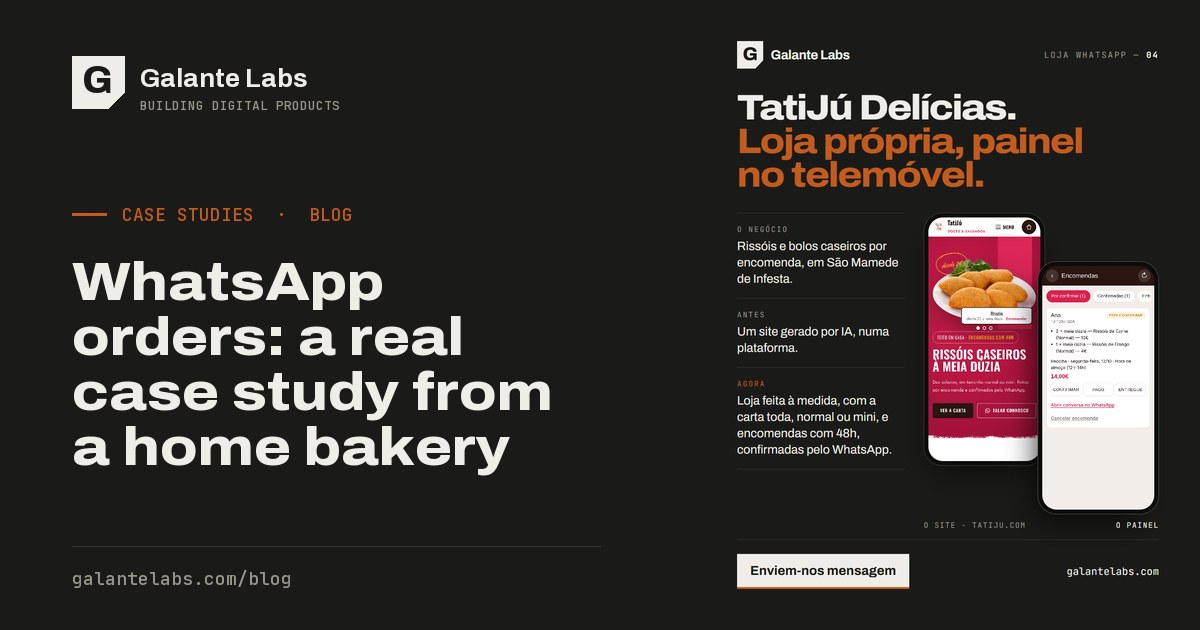
TatiJú Delícias makes homemade savoury pastries and cakes to order in São Mamede de Infesta, just north of Porto. They had an AI-generated website that showed the products but didn't organise orders. Today they have their own store at tatiju.com: the customer picks from the menu, chooses a day, and the order reaches WhatsApp already written, with an order number, products, total and pickup time.
This article shows how the store is built, why we chose this format instead of a traditional online store, and what you can copy for your own business.
The starting point: a website that didn't take orders
TatiJú sells home cooking, made to order. That comes with its own rules. Everything is prepared for a specific day. Rissóis (breaded half-moon pastries, a Portuguese party classic) are sold by the half dozen, in regular or mini size. And the kitchen needs to know in advance what it is going to make.
The previous site had been generated by AI on a website platform. It looked fine at first glance, but it didn't solve the core problem. Customers saw photos and then had to send a message asking for the price, the flavours, whether there was availability on Saturday. Each order was pieced together across a conversation.
It's the same problem I wrote about in selling through DMs is costing you sales: the same questions come back all day, and every order depends on someone being free to reply.
How the TatiJú store works

1. The full menu, with prices
Ten flavours of rissóis, chicken coxinhas, codfish cakes, cakes, tarts and desserts. Every product shows the price per half dozen, regular and mini. Customers don't have to ask anything to know what they'll pay.
2. The customer picks the day
Everything is made with at least 48 hours' notice, and the store says so right at the top. There's even a countdown: to get your order on Saturday, it has to come in by Thursday. The customer chooses pickup or delivery, the day, and a time window (morning, lunchtime, afternoon or early evening).
3. The message arrives already written
At the end, the customer adds their name and phone number and taps "Send order via WhatsApp". WhatsApp opens with the message ready: order number, each product with quantity and price, total, day and time. TatiJú gets everything in a single message, always in the same format.
4. A person confirms it
The order is only confirmed when TatiJú replies. That's deliberate. In a home kitchen, the person who decides whether there's room for thirty more pastries on Saturday is the person who will make them. Delivery and payment are arranged in that same conversation.
The dashboard on the phone
On TatiJú's side, orders show up in a dashboard that works on the phone, with no app to install. It's split into orders to confirm, confirmed and delivered. Each one has three buttons: confirm, paid and delivered. One tap opens the conversation with the customer on WhatsApp.
The same dashboard is where prices change and products get marked as sold out. If they run out of shrimp filling, that product comes off the menu in seconds, without calling me.
This is what small businesses ask me for most often. They don't want to learn a complicated system. They want to see, on the phone already in their hand, what needs doing today.
Why not a traditional online store
I've been building Shopify stores for 10 years and I enjoy it. But they aren't the answer for every business. For TatiJú, a store that charges at checkout would have created more problems than it solved:
- Payment would come before confirmation. If the customer pays and the kitchen has no capacity that day, the money has to be refunded.
- Deliveries are arranged case by case. The price depends on the address, and that's easier to settle in a message than in a shipping rate table.
- Customers were already on WhatsApp. Asking them to create an account or fill in a long checkout would add friction where there was none.
The rule I use in first conversations is simple: the tool should adapt to how the business already works, not the other way round. When a business grows into daily shipping, stock control and automatic invoicing, that's when a full Shopify store makes sense.
What you can copy for your business
Even if you don't sell food, these ideas work for almost any business that sells through messages:
- Show your prices. Every price question a customer doesn't ask is a conversation you don't have to have.
- State the rules before anyone asks. Notice period, delivery area, how to pay. TatiJú puts "48h" at the top of the page.
- Make orders arrive organised. One message with everything, always in the same format, is faster to confirm than ten scattered ones.
- Keep the human part where it counts. Confirming, arranging delivery, handling special requests. The rest can be automatic.
- Keep everything in your name. At TatiJú, the domain, the content and the customer contacts belong to TatiJú.
Frequently asked questions
What is a WhatsApp store?
It's a store in a single link (for your Instagram bio, for example) with your catalogue, prices, sizes and stock. The customer chooses and the order reaches WhatsApp already written. It includes a phone dashboard to confirm orders, change prices and mark products as sold out.
Does the customer need to install anything?
No. The store opens in the browser and the order goes through the WhatsApp the customer already uses. There's nothing to install on the business side either: the dashboard works on the phone.
How do payments work?
It depends on the business. At TatiJú, payment is arranged on WhatsApp when the order is confirmed. In other stores, the customer sees the payment details straight away and pays by MB WAY (Portugal's mobile payment app) or bank transfer, then sends the receipt. There are no commissions, and the money goes straight to the store's account.
How long does it take?
The store goes live within 7 working days of receiving your photos and prices.