Selling through DMs is costing you sales
Answering “price?” and “still available?” one message at a time loses customers. Why it happens, what it costs and how to sell without depending on DMs.
 Rita GalanteFounder and Shopify developer
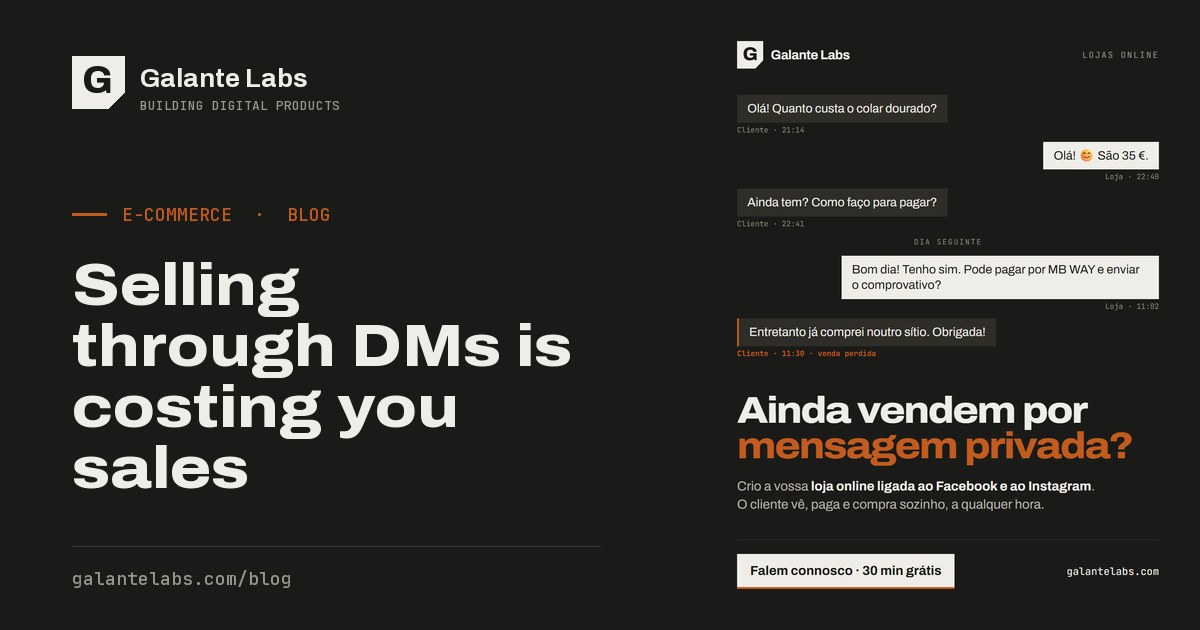
A lot of small businesses sell like this: they post on Instagram or Facebook, a customer sends a message asking for the price, someone replies when they can, they agree on payment, they agree on shipping. It works at first. The problem is that, past a certain point, every sale depends on someone being available to reply.
I see this in almost every first conversation I have with small stores. The chat in the image above is real in shape, even if the names aren’t: the customer asks at 21:14, the reply arrives at 22:40, she asks how to pay, the next reply only comes in the morning, and in the meantime she has bought somewhere else.
Why DMs lose sales
The customer wants to buy now
Someone who messages to ask the price is already interested. They are in the moment of deciding. Every hour of waiting gives them time to compare, to get distracted or to find the same product in another store that answers on its own.
The same questions, all day long
“Price?”, “do you have it in M?”, “still available?”, “do you ship?”, “how do I pay?”. It’s always the same five questions, asked by different people on different posts. Whoever answers them all is doing a catalogue’s job by hand.
Products end up scattered
The necklace is in a reel from two weeks ago, the jumper in a story that has already disappeared, the prices in a comment. The customer has nowhere to see everything, and you have nowhere to see what has sold.
Payment gets stuck halfway
“Can you pay by MB WAY and send the receipt?” works, but it means one more round of messages, checking the payment by hand and keeping the receipt somewhere. It’s one more step where the sale can get lost.
What changes when customers can buy on their own
An online store solves this for one simple reason: it answers the five questions before the customer asks them. The price, sizes, colours and stock are there. So are payment and shipping. The customer chooses, pays and the order reaches you organised, at any time, even while you sleep.
It doesn’t mean you stop talking to customers. It means conversations are about what matters (a question about fit, a special request), not about the price that was already in the post.
Which kind of store makes sense
It depends on how much you sell and how you sell:
- You sell mostly through social media, with few products. A simple catalogue is often enough: one link in your bio, orders arrive already written, and payment is by MB WAY or bank transfer.
- You have many products, variants and daily shipments. Here a Shopify store pays off, with automatic payments, synced stock and certified invoicing connected to the store.
- You sell personalised pieces (colour, size, engraving). The messages exist because the customer needs to see how it will look. A configurator on the product page answers that without a conversation.
Either way, the goal is the same: customers should be able to buy without waiting for you.
Where to start
- Count a week’s messages. How many are questions about price, size, stock, shipping or payment? That number tells you how much time goes into repeated answers.
- Put your products in one place. Even before having a store, a catalogue with prices and sizes in one link cuts half the questions.
- Choose a payment method that doesn’t depend on you. Customers should see the exact amount and payment details without having to ask.
- Get a second opinion. I do a free audit: I look at how you sell today and tell you which of these paths makes most sense, no strings attached.
Frequently asked questions
Do I need to stop selling on Instagram?
No. Social media is still where people discover you. The store becomes the place you send them when they want to buy: the link in your bio, in stories and in replies.
Is an online store expensive for a small business?
It depends on what you need. A simple catalogue costs much less than a full Shopify store, and an Essential Shopify store starts at €1,800 + VAT. What usually costs most is to keep losing sales for lack of a reply.
Can I keep taking MB WAY payments?
Yes. Both a simple catalogue and a Shopify store can accept MB WAY. The difference is that customers see the amount and payment details without having to ask.